I decided to make a list of DM stuff that I personally use or think are important to know when it comes to being a DM. So here’s my list:
Medieval Fantasy City Generator: This generator is now my LIFE. It generates incredibly complex cities with good customization. (Thanks to plantkat for sharing this site in their post here)
Naming Your Towns/Cities:Now that you’ve made your city, time to name it and give it some character! This post contains lots of great information.
Index Cards Rule:Fuckyeahdnd shared a SUPER convenient way of keeping track of turns and HP in combat. I use this system now for every single session I run.
Troublesome Players? Speak Up:Dicebound brings up an incredibly great point. If someone is being a jerk, speak up and call them out. This is especially important and relevant now to crush awful behavior before it even has a chance to show it’s ugly face.
(Character stuff, spells, online communities/ways to play, etc..)
A lot of people contributed to this post but thank you Mushroomancy for posting the original list.
Donjon: And finally, this site is a great resource for looking up Spells and Monsters along with tons of other generators. Not every single Spell or Monster is on here, but most are listed.
(I tried to give credit to the original posters or the actual URL for websites, unless those sites or URLs were no longer active)
IF IT HAS BEEN A VERY LONG DAY, YOU ARE ‘WEARY’. IF SOMEONE IS ACTING IN A WAY THAT MAKES YOU SUSPICIOUS, YOU ARE ‘WARY’.
ALL IN ‘DUE’ TIME, NOT ‘DO’ TIME
‘PER SE’ NOT ‘PER SAY’
THANK YOU
BREATHE – THE VERB FORM IN PRESENT TENSE
BREATH – THE NOUN FORM
THEY ARE NOT INTERCHANGEABLE
WANDER – TO WALK ABOUT AIMLESSLY
WONDER – TO THINK OF IN A DREAMLIKE AND/OR WISTFUL MANNER
THEY ARE NOT INTERCHANGEABLE (but one’s mind can wander)
DEFIANT – RESISTANT DEFINITE – CERTAIN
WANTON – DELIBERATE AND UNPROVOKED ACTION (ALSO AN ARCHAIC TERM FOR A PROMISCUOUS WOMAN)
WONTON – IT’S A DUMPLING THAT’S ALL IT IS IT’S A FUCKING DUMPLING
BAWL- TO SOB/CRY
BALL- A FUCKING BALL
YOU CANNOT “BALL” YOUR EYES OUT
AND FOR FUCK’S SAKE, IT’S NOT “SIKE”; IT’S “PSYCH”. AS IN “I PSYCHED YOU OUT”; BECAUSE YOU MOMENTARILY MADE SOMEONE BELIEVE SOMETHING THAT WASN’T TRUE.
THANK YOU.
*slams reblog*
IT’S ‘MIGHT AS WELL’. ‘MIND AS WELL’ DOES NOT MAKE GRAMMATICAL SENSE.
A SNEAK PEAK WOULD BE A MOUNTAIN ENGAGED IN ESPIONAGE
THEY ARE VERY LARGE AND WOULD FIND THIS GENERALLY DIFFICULT
THANK
(OH AND ONE OTHER THING
BULLION = PRECIOUS METAL
BOUILLON = STOCK, FROM THE FRENCH “BOUILLER,” TO BOIL)
SHUDDER:
SHUTTER:
NOT SAME NOT SAME
sleight of hand: magic tricks
slight of hand: President-Elect
I love this post so much oh my god 😂
“A MOUNTAIN ENGAGED IN ESPIONAGE” I’m losing my shit
To my followers who speak & write in English as a second language: the caps locks and the frustration might come across as scary or even personally pointed, but all the information is valuable, even (and lbr ESPECIALLY) to native English speakers & writers!
Break= To shatter, stop working, be made to fall apart; the verb and noun form of “broken”
Brake= To attempt to stop; the part of a vehicle that allows one to stop
Reign = To rule
Rein = A long, narrow strap used to guide or check a horse
LOOSE means “not tight.”
LOSE means “to misplace.”
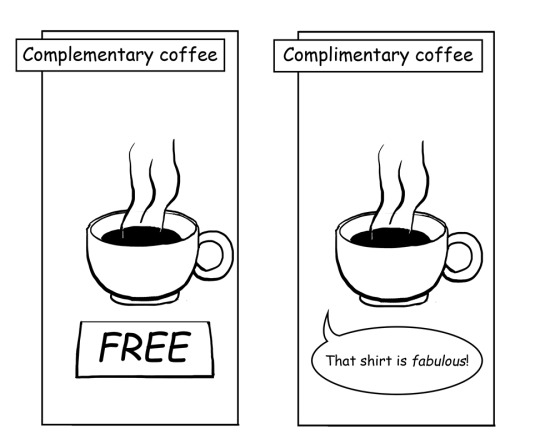
The “complimentary” vs “complementary” example is actually wrong. Both instances would warrant the use of “complimentary.”
“Complementary” means harmonious or compatible. Not “free of charge.”
*Pushes glasses up on nose*
The discreet vs discrete one drives me crazy
They left out my pet peeve: you don’t “pour over” a document – that would make it wet and unreadable. You “pore over” a document. Imagine you’re looking so closely that you could see its pores, if it had any.
Sticking a landing will royally fuck up your joints and possibly shatter your ankles, depending on how high you’re jumping/falling from. There’s a very good reason free-runners dive and roll.
Hand-to-hand fights usually only last a matter of seconds, sometimes a few minutes. It’s exhausting work and unless you have a lot of training and history with hand-to-hand combat, you’re going to tire out really fast.
Arrows are very effective and you can’t just yank them out without doing a lot of damage. Most of the time the head of the arrow will break off inside the body if you try pulling it out, and arrows are built to pierce deep. An arrow wound demands medical attention.
Throwing your opponent across the room is really not all that smart. You’re giving them the chance to get up and run away. Unless you’re trying to put distance between you so you can shoot them or something, don’t throw them.
Everyone has something called a “flinch response” when they fight. This is pretty much the brain’s way of telling you “get the fuck out of here or we’re gonna die.” Experienced fighters have trained to suppress this. Think about how long your character has been fighting. A character in a fist fight for the first time is going to take a few hits before their survival instinct kicks in and they start hitting back. A character in a fist fight for the eighth time that week is going to respond a little differently.
ADRENALINE WORKS AGAINST YOU WHEN YOU FIGHT. THIS IS IMPORTANT. A lot of times people think that adrenaline will kick in and give you some badass fighting skills, but it’s actually the opposite. Adrenaline is what tires you out in a battle and it also affects the fighter’s efficacy – meaning it makes them shaky and inaccurate, and overall they lose about 60% of their fighting skill because their brain is focusing on not dying. Adrenaline keeps you alive, it doesn’t give you the skill to pull off a perfect roundhouse kick to the opponent’s face.
Swords WILL bend or break if you hit something hard enough. They also dull easily and take a lot of maintenance. In reality, someone who fights with a sword would have to have to repair or replace it constantly.
Fights get messy. There’s blood and sweat everywhere, and that will make it hard to hold your weapon or get a good grip on someone.
A serious battle also smells horrible. There’s lots of sweat, but also the smell of urine and feces. After someone dies, their bowels and bladder empty. There might also be some questionable things on the ground which can be very psychologically traumatizing. Remember to think about all of the character’s senses when they’re in a fight. Everything WILL affect them in some way.
If your sword is sharpened down to a fine edge, the rest of the blade can’t go through the cut you make. You’ll just end up putting a tiny, shallow scratch in the surface of whatever you strike, and you could probably break your sword.
ARCHERS ARE STRONG TOO. Have you ever drawn a bow? It takes a lot of strength, especially when you’re shooting a bow with a higher draw weight. Draw weight basically means “the amount of force you have to use to pull this sucker back enough to fire it.” To give you an idea of how that works, here’s a helpful link to tell you about finding bow sizes and draw weights for your characters. (CLICK ME)
If an archer has to use a bow they’re not used to, it will probably throw them off a little until they’ve done a few practice shots with it and figured out its draw weight and stability.
People bleed. If they get punched in the face, they’ll probably get a bloody nose. If they get stabbed or cut somehow, they’ll bleed accordingly. And if they’ve been fighting for a while, they’ve got a LOT of blood rushing around to provide them with oxygen. They’re going to bleed a lot.
Here’s a link to a chart to show you how much blood a person can lose without dying. (CLICK ME)
If you want a more in-depth medical chart, try this one. (CLICK ME)
Hopefully this helps someone out there. If you reblog, feel free to add more tips for writers or correct anything I’ve gotten wrong here.
How to apply Writing techniques for action scenes:
– Short sentences. Choppy. One action, then another. When there’s a lull in the fight, take a moment, using longer phrases to analyze the situation–then dive back in. Snap, snap, snap. – Same thing with words – short, simple, and strong in the thick of battle. Save the longer syllables for elsewhere. – Characters do not dwell on things when they are in the heat of the moment. They will get punched in the face. Focus on actions, not thoughts. – Go back and cut out as many adverbs as possible. – No seriously, if there’s ever a time to use the strongest verbs in your vocabulary – Bellow, thrash, heave, shriek, snarl, splinter, bolt, hurtle, crumble, shatter, charge, raze – it’s now. – Don’t forget your other senses. People might not even be sure what they saw during a fight, but they always know how they felt. – Taste: Dry mouth, salt from sweat, copper tang from blood, etc – Smell: OP nailed it – Touch: Headache, sore muscles, tense muscles, exhaustion, blood pounding. Bruised knuckles/bowstring fingers. Injuries that ache and pulse, sting and flare white hot with pain. – Pain will stay with a character. Even if it’s minor. – Sound and sight might blur or sharpen depending on the character and their experience/exhaustion. Colors and quick movements will catch the eye. Loud sounds or noises from behind may serve as a fighter’s only alert before an attack. – If something unexpected happens, shifting the character’s whole attention to that thing will shift the Audience’s attention, too. – Aftermath. This is where the details resurface, the characters pick up things they cast aside during the fight, both literally and metaphorically. Fights are chaotic, fast paced, and self-centered. Characters know only their self, their goals, what’s in their way, and the quickest way around those threats. The aftermath is when people can regain their emotions, their relationships, their rationality/introspection, and anything else they couldn’t afford to think or feel while their lives were on the line.
Do everything you can to keep the fight here and now. Maximize the physical, minimize the theoretical. Keep things immediate – no theories or what ifs.
If writing a strategist, who needs to think ahead, try this: keep strategy to before-and-after fights. Lay out plans in calm periods, try to guess what enemies are thinking or what they will do. During combat, however, the character should think about his options, enemies, and terrain in immediate terms; that is, in shapes and direction. (Large enemy rushing me; dive left, circle around / Scaffolding on fire, pool below me / two foes helping each other, separate them.)
Lastly, after writing, read it aloud. Anyplace your tongue catches up on a fast moving scene, edit. Smooth action scenes rarely come on the first try.
More for martial arts or hand-to-hand in general
What a character’s wearing will affect how they fight. The more restricting the clothes, the harder it will be. If they’re wearing a skirt that is loose enough to fight in, modesty will be lost in a life or death situation.
Jewelry can also be very bad. Necklaces can be grabbed onto. Bracelets also can be grabbed onto or inhibit movement. Rings it can depend on the person.
Shoes also matter. Tennis shoes are good and solid, but if you’re unused to them there’s a chance of accidentally hurting your ankle. High heels can definitely be a problem. However, they can also make very good weapons, especially for someone used to balancing on the balls of their feet. Side kicks and thrusting kicks in soft areas (like the solar plexus) or the feet are good ideas. They can also (hopefully) be taken off quickly and used as a hand weapon. Combat boots are great but if someone relies more on speed or aren’t used to them, they can weigh a person down. Cowboy boots can be surprisingly good. Spin kicks (if a character is quick enough to use them) are especially nasty in these shoes.
If a character is going to fight barefoot, please keep location in mind. Concrete can mess up your feet quick. Lawns, yards, etc often have hidden holes and other obstacles that can mess up a fighter. Tile floors or waxed wood can be very slippery if you’re not careful or used to them.
Likewise, if it’s outside be aware of how weather will affect the fight. The sun’s glare can really impede a fighter’s sight. A wet location, inside or outside, can cause a fighter to slip and fall. Sweat on the body can cause a fighter to lose a grip on an opponent too.
Pressure points for a trained fighter are great places to aim for in a fight. The solar plexus is another great place to aim for. It will knock the wind out of anyone and immediately weaken your opponent.
It your character is hit in the solar plexus and isn’t trained, they’re going down. The first time you get hit there you are out of breath and most people double over in confusion and pain. If a fighter is more used to it, they will stand tall and expand themselves in order to get some breath. They will likely keep fighting, but until their breath returns to normal, they will be considerably weaker.
Do not be afraid to have your character use obstacles in their environment. Pillars, boxes, bookshelves, doors, etc. They put distance between you and an opponent which can allow you to catch your breath.
Do not be afraid to have your character use objects in their environment. Someone’s coming at you with a spear, trident, etc, then pick up a chair and get it caught in the legs or use it as a shield. Bedsheets can make a good distraction and tangle someone up. Someone’s invading your home and you need to defend yourself? Throw a lamp. Anything can be turned into a weapon.
Guns often miss their targets at longer distances, even by those who have trained heavily with them. They can also be easier to disarm as they only shoot in one direction. However, depending on the type, grabbing onto the top is a very very bad idea. There is a good likelihood you WILL get hurt.
Knives are nasty weapons by someone who knows what they’re doing. Good fighters never hold a knife the way you would when cutting food. It is best used when held against the forearm. In defense, this makes a block more effective and in offense, slashing movement from any direction are going to be bad. If a character is in a fight with a knife or trying to disarm one, they will get hurt.
Soft areas hit with hard body parts. Hard areas hit with soft body parts. The neck, stomach, and other soft areas are best hit with punches, side kicks, elbows, and other hard body parts. Head and other hard parts are best hit using a knife hand, palm strike, etc. Spin kicks will be nasty regardless of what you’re aiming for it they land.
Common misconception with round house kicks is that you’re hitting with the top of the foot. You’re hitting with the ball. You’re likely to break your foot when hitting with the top.
When punching, the thumb is outside of the fist. You’ll break something if you’re hitting with the thumb inside, which a lot of inexperienced fighters do.
Also, punching the face or jaw can hurt.
It can be hard to grab a punch if you’re not experienced with it despite how easy movies make it seem. It’s best to dodge or redirect it.
Hitting to the head is not always the best idea. It can take a bit of training to be able to reach for the head with a kick because of the height. Flexibility is very much needed. If there are problems with their hips or they just aren’t very flexible, kicks to the head aren’t happening.
Jump kicks are a good way to hit the head, but an opponent will see it coming if it’s too slow or they are fast/experienced.
A good kick can throw an opponent back or knock them to the ground. If the person you’ve hit has experience though, they’ll immediately be getting up again.
Even if they’ve trained for years in a martial art, if they haven’t actually hit anything before or gotten hit, it will be slightly stunning for the person. It does not feel the way you expect it too.
Those yells in martial arts are not just for show. If done right, they tighten your core making it easier to take a hit in that area. Also, they can be used to intimidate an opponent. Yelling or screaming right by their ear can startle someone. (Generally, KHR fans look at Squalo for yelling)
Biting can also be used if someone’s grabbing you. Spitting in someone’s eyes can’t hurt. Also, in a chokehold or if someone is trying to grab your neck in general, PUT YOU CHIN DOWN. This cuts off access and if they’re grabbing in the front can dig into their hand and hurt.
Wrist grabs and other grabs can be good. Especially if it’s the first move an opponent makes and the character is trained, there are simple ways to counter that will have a person on their knees in seconds..
Use what your character has to their advantage. If they’re smaller or have less mass, then they’ll be relying on speed, intelligence, evasion, and other similar tactics. Larger opponents will be able to take hits better, they’re hits may be slower depending on who it is but will hurt like hell if they land, and size can be intimidating. Taller people with longer legs will want to rely on kicking and keeping their distance since they have the advantage there. Shorter people will want to keep the distance closer where it’s easier for them but harder for a taller opponent. Punching is a good idea.
Using a person’s momentum against them is great. There’s martial arts that revolve around this whole concept. They throw a punch? Grab it and pull them forward and around. Their momentum will keep them going and knock them off balance.
Leverage can used in the same way. If used right, you can flip a person, dislocate a shoulder, throw out a knee, etc.
One note on adrenaline: All that was said above is true about it. But, in a fight, it can also make you more aware of what’s going on. A fight that lasts twenty seconds can feel like a minute because time seems to almost slow down while moving extremely rapidly. You only have so much time to think about what you’re doing. You’re taking in information constantly and trying to adjust. Even in the slow down adrenaline gives you, everything is moving very rapidly.
Feelings will be your downfall even more so than adrenaline. Adrenaline can make those feelings more intense, but a good fighter has learned not to listen to those feelings. A good fighter may feel anger at being knocked down or in some way humiliated – their pride taken down. Yet they will not act on the anger. Acting on it makes a fighter more instinctive and many will charge without thinking. Losing control of anything (adrenaline rush, emotions, technique, etc) can be a terrible thing in a fight.
Just thought I’d add in here.
YES. YES.
Just wanted to add some stuff!
– You don’t clash swords edge-to-edge like they do in movies/anime/whatever. That’s a good way to chip your blade or get your blades stuck together (which admittedly would be cool to see characters deal with). A good swordsperson would block with the flat of the blade.
– Trained fighters, whether empty-handed or with weapons, circle their opponents and move at angles to gain an advantage. Use this! It can make things more dramatic.
– Trying to block a knife with anything but a some sort of shield is a Very Bad Idea. If you’re trained, you can try to redirect it but even then it’s a crapshoot if you’re not trained in knife fighting. To get an idea, try knife sparring with someone (with training knives obvs unless you like to live dangerously). Shit’s hard to block and KNIVES ARE FAST.
– If people are both armed and in a knife fight and there’s no escaping, both WILL get cut unless one is a total moron with a knife. Again, KNIVES ARE FAST.
– Wristlocks are very effective, but if you got two people going at it with all the adrenaline pumping, trying to lock the wrist or arm right off the bat probably won’t fly. These are most effective when done out of a flow, like doing punch combo into a wrist lock or blocking an opponent’s attack and pulling their arm into a lock.
– Dirty fighting! If you got characters fighting for survival, have them go for the eyes! Punch the neck! Grab a fistful of hair to control your opponent’s head! Stomp on feet! Break body parts! GRAHHHHHHH
– Elbows hurt. Don’t forget elbows.
– Also knees.
– And shins. Getting a full-power round kick with a shin is pretty intense.
– Fighting from the ground! Just because a character is on the ground doesn’t mean they can’t still swing their weapon at their standing opponent. It’s a thing we’d train in kali! Also if both fighters are on the ground, they can grapple and do cool shit like leg locks.
– Headbutts are a thing! But don’t have them headbutt with their forehead because owie. Top of the head or top-side-ish of the head is best.
– Grabbing someone’s clothes. It can be very effective in controlling your opponent if you’re trained. Check out BJJ with gi!
M-most people don’t t-talk like th-this when they st-stutter from n-nerves.
It’s more…it’s more like going back and…and starting over. Maybe repeating some, some words.
Bonus tip: this is ESPECIALLY true in thoughts. Thoughts are a lot more fluid than speech because there’s no physical barrier to get past when they form into words.
Thank you for the tips!
Stuttering like this is closer to what happens when somebody’s got a speech impediment that makes it difficult for them to form words. It’s not that it doesn’t happen, it’s just that it happens in different circumstances from what people think! Like OP said, somebody who’s got no speech impediment but is stuttering when they’re nervous is gonna sound more like:
“I… I don’t… This can’t… No, I-I don’t have ANY idea what’s happening here.”
…rather than: “I-I d-don’t have an-ny id-d-dea what’s h-happening here!”
has detailed if not meticulous notes on the universe they’ve created, down to the food eaten and language quirks, they use mythos and setting to bring it all together
most of the character’s backstories are already loving laid out, though may not be all connected yet.
Has yet to write a full chapter. (But they’re getting there!)
The Bae
Story is centered around a complex and engaging OC that they’ve spent years developing
said OC has been through A Lot, the love is real, so is the pain
OC may sort of be a loser? ie the story is a character-driven piece where the plot is moved ahead by said character’s bad decisions and questionable habits
The Researcher
akin to the lore-ist but spends more of their time on wikipedia articles jotting down notes and things like how much a watermelon weighs
Everything from knowing Too Much about child-care to how a body decomposes or flapper chest-binding is on the table, their breadth is large and Should Be Feared
takes a long time to start but make the most of their words, from spot-on sci-fi to history to murder, readers will learn something on the way
The Lemon Flavored Factory
alright take it back now y’all, this writer has written enough smut to make a tom cat blush, they can write other things too, and often well, but there will inevitably be bed-rattling at some point (or car or shower)
either unusually creative or just sticks to classics like Aliens Made Them Do It, neither is necessarily bad but there is oddly little in between
their author’s notes tend to be hilarious or at least very self-aware
The Word Vomit Canoe
action oriented writer who spews out the words before they know what is happening, no plans, no outlines, 10k of the first thing that comes to mind, sometimes things like ‘maybe dragons?’ & they go with it
their strengths are productivity, weaknesses are not knowing what the hell is going on
style is marked by fast-paced tone and downright impressive word count
The Muse
their inspiration doesn’t come as often, but they are always listening for her & redy 2 go
update schedule is…sporadic at best, but makes up for it with long chapters and clean editing
Will write 30 pages in a day and then take a few months off, enjoys one-shots but can do longer works
doesn’t have the best sense of time and when they are in The Zone may forget to eat or shower
There are many ways to use color in magick. Here are just a few examples:
You can choose clothing, altar cloths, chord, candles, and almost anything else in colors associated with the intent of your spell or ritual.
You can write spells, incantations, talismans, and sigils using ink or colored pencils in colors corresponding to the magick you are working.
When meditating, you can envision yourself surrounded by light in a color associated with your purpose.
Black
Grounding, wisdom, learning, protection, safety, reversing, uncrossing, unhexing, repelling black magick, banishing negativity, releasing, shapeshifting, defense, scrying, pride
Blue
Communication, will power, focus, forgiveness, good fortune, weight loss, truth, fidelity, patience, domestic harmony, organization, removing bad vibrations, sincerity, astral projection, water element
Brown
House blessing, animal/pet magick, earth magick, concentration, material goods, stability, locating lost objects, earth element, real estate, construction, food, financial crisis
Copper
Business success, passion, money, fertility, career growth
Gold
Masculine divinity, great fortune, abundance, prosperity, male energy, understanding, divination, fast luck, solar/sun energy, positive attitude, justice, health, attraction, luxury
People in the Middle Ages valued sweet smelling breath and bodies, seeing them as desirable, so there is a great deal of evidence from the period of tooth pastes, powders and deodorants.
Contrary to the typical Hollywood depiction of medieval peasants with blackened and rotting teeth, the average person had teeth which were in fairly good condition, mainly due to the rarity of sugar in the diet. Most medieval people could not afford sugar and those who could used it sparingly.
Archaeological data shows that only 20% of teeth had signs of decay, as opposed to 90% in the early twentieth century. The main dental problem for medieval people was not decay but wear, due to a high content of grit in the main staple, bread.
For deodorants, soap was available for the wealthy, but a variety of herbs and other preparations were also used. Soapwort is a plant native to Europe and Asia which, when soaked in water, produces an effective liquid soap. Mint, cloves and thyme were also extensively used by simply rubbing into the skin, and alum (hydrated potassium aluminium sulphate) was an effective deodorant.
I am trying to keep to 14th century technology on my pilgrimage to Canterbury, which gives me various options when looking at hygiene. In the middle ages people generally cleaned their teeth by rubbing them and their gums with a rough linen cloth, or the chewed end of a stick. There are various recipes for pastes and powders that could be put on the cloth to help clean the teeth, but I have chosen simple salt to whiten them and to aid fresh breath. I will also be using the stick method, and will be taking along a supply of liquorice root sticks for that purpose.
I also have a few blocks of alum, which when rubbed into wet skin has a deodorising effect. Alum, like beeswax, was used extensively in the middle ages for a variety of purposes, also being useful:
* in the purification of drinking water as a flocculant * as a styptic to stop bleeding from minor cuts * as a pickling agent to help keep pickles crisp * as a flame retardant * as an ingredient in modelling clay * as an ingredient in cosmetics and skin whiteners * as an ingredient in some brands of toothpaste
The photograph shows my wash kit including home made olive oil soap, salt for the teeth, a block of deodorising alum, cloves, a boxwood comb made for me by Peter Crossman of Crossman Crafts and some liquorice root sticks, all on a woollen ‘towel’. Note that the cloves are kept in a ventilated box….this is because insects hate the smell of cloves and so a perforated box will keep them out of my kit and food bag when I am sleeping rough. TIP: If you steep some cloves to obtain the oil and put the liquid around the doors and windows of your house, it keeps spiders and insects out.
Pay attention medieval-ish fantasy authors- filthy people without any cleaning or self care is Not Historical.
Sometimes, writers find it necessary to add more depth to the world surrounding their characters. I’ve collected a few links that should be helpful in this process. Some of these are better for a fantasy stories, but have ideas that could prove useful for writers of all genres, in one way or another.
MAP GENERATION If you have decided to create your own land mass for the sake of your story, you may be grateful to have this link. Users should read the description below before using, but it is easy to use and helpful for anyone wanting to create a new island or continent. I prefer using this tool over any others I’ve seen online. This website only contains the demo. The full version has more ways to edit the map, but getting the full version requires downloading and having proper software. I’ve found that the demo, on its own, should be enough for anyone who can’t get the full version for one reason or another. However, the link for full version is also on the page, should you want it.
WEATHER AROUND THE WORLD Knowing weather details of areas can be helpful when writing about an area, especially if it’s one you’re not familiar with. This website has the recorded weather of pretty much everywhere on Earth, and even provides averages for the past year in specific areas. It’s great for writers who want an understanding of how the weather in their story might affect the characters. For instance: if the summer heat in an area is consistently over 100 degrees, the characters might be less willing to go outside, and be in need of constant hydration.
FANTASY JOBS THAT AREN’T KNIGHT OR PEASANT Anyone who is writing a story that takes place in a less developed civilization, be it medieval times, or a fantasy world that hasn’t quite hit its industrial revolution, should probably have this list. It’s a simple list of a 100 jobs that you might consider giving to the characters in your story to make them seem like real people. The creator of the list even adds a few at the end for younger characters. Choosing any of them for your story may take some added research, but will be worth the depth added to your story.
FAMILY TREE TOOL If you’ve ever read the series “Lord of the Rings”, you may know that pretty much everyone in the books has a long list of ancestors. While I would never endure such an endeavor, if you feel so inclined to come up with a lineage for your character, this is a tool you can use. It’s easy to use, and allows for adding information beyond name and year of birth/death. You’re able to change what information shows up on the table, and when finished you can even print it out.
HOME DESIGNER So this is good if you have time to kill and really want to do some in-depth building. This tool will let you be the designer of the home of your characters. You’ll get out what you put into it, so if your character lives in a three story, 10 bedroom home, you may have to put in a bit more effort to use this tool effectively. You can also simply create individual rooms, if that’s more along the lines of what you want. Over all, while this tool may take a bit of time to learn, it isn’t very complicated. I suggest it to everyone who wants to explore how the home of their characters looks.
LANGUAGE CREATION If you were thinking about writing your own language, this link will make you decide whether you really want to create your own language, or if you want to give up on the idea entirely. It’s a long process, but is completely spelled out in this link, and the additional pages that the website provides links to. You can also buy the book by the same author for $0.99; but all the information is available for free. Either way, it should be an easy choice to make after reading through what the website has to offer. I think creating a language is for people with more time, patience, and understanding of their own language than I have, but it is certainly fun to think about. The author also discusses different methods people use to create languages, and what is wrong with those methods. I believe this is, by far, the best resource for creating a language.
For more information on my blog please visit my ABOUT PAGE




 AllHailMephlis' Blog