Ancient Persian engineers made their
own freezers that kept ice cold – even
during desert summers. By 400 BCE, they
had perfected the ‘yakhchal,’ which are
made of thick, heat-resistant materials.
They had vents to funnel breezes to an
underground storage area and push
warm air out the top, and ice could be
brought in during winter to use for
making chilled treats in the summer. SourceSource 2
Well, I’m bored, so inspired by our Captain’s post about Naval Flags, I decided I was going to do a short bit on something common to all Knights and nobles; Heraldry!
Let’s begin! —
WHAT IS HERALDRY?
Heraldry is a pretty broad term, but generally refers to a
Coat of Arms, personal, hereditary, military, or to some extent, even national.
This usually takes the form of a shield or badge with associated colours,
symbols, or heraldic beasts, mottoes, and occasionally a crest.
It is important to note a crest and a heraldic Coat of Arms are not the same
thing; a crest refers to a 3D icon placed atop a helmet. Often this is related
to the family of the one wearing the said crest, but not always.
WHAT IS IT FOR?
Heraldry has kind of been in use since antiquity, but the
essential purpose is to identify yourself and your allegiance. It’s not too
dissimilar to modern forms of identification. For a Knight in the mediaeval
period of history (so; fall of Rome onward to early Modern period), their
heraldry was a way of declaring “I am Sir/Dame X of Y, belonging to house Z,
etc”. Naturally, you’d think someone could just create their own heraldry and
blag their way to the top, but Heralds kept a close eye upon which house had
what heraldry, meaning it was not an easy task to create a convincing bit of
heraldry without close scrutiny. Not to say it didn’t happen; it was just
difficult.
Naturally, a person or family that was ennobled had the right to create their
own heraldry, thus having special permission to do so.
Heraldry also played a part in combat; Knights would often avoid targets
without heraldry, seeing the average soldier as beneath them, and targeting only
other knights specifically. Or at least, ideally they would have done so. In
reality, and especially toward the late mediaeval period, Knights would target
anything in their way. However, even then, heraldry served the purpose of
revealing whom was whom, what allegiance they held, and what forces they had
gathered about them. Wearing your heraldic banner allowed your allies to rally
around you, but also allowed enemies to focus upon you, making it a
double-edged sword. However, glory-seeking Knights favoured open displays of
their valour, thus it was considered honourable to display one’s Heraldry in
battle.
HOW DOES IT WORK?
Well that’s a pretty broad function to narrow down, but let’s
focus upon the basics here:
To create heraldry, you have to use an assortment of things: ·
– a shield/badge·
– a heraldic symbol or beast·
– personal colours of Heraldic specification
(Tinctures)·
– Occasionally (especially in modern military and
academic organisations), a motto All these things should be fairly unique and personal, which
differentiates the bearer and marks them out. Remember; this is a form of
identity!
(EXAMPLE)
Knight will use their own Coat of Arms for reference (no I’m not about to show
you an image of it; that’d be telling), via description:
Knight’s Family Coat-of-Arms is a Shield/Field (Verte), slashed with Crosses
(Ermine). The small crosses are all that separates this heraldic Coat from the
similar Heraldry of the Kingsley Family.
So to translate that: Green Shield, White Crosses/Lines, Black small crosses.
The heraldic beast used as a crest for Knight’s family is usually depicted as
either a Goat’s head or an Antelope, depending upon stylistic depiction, though
more commonly the Goat.
The Motto is (as mottos often were), fluid, and there are two different mottos
associated with the Family, specifically: “Virtute et Fortutido” and “Haud
Facile”, meaning, respectfully: “By Valour and Strength” and “Not With Ease”.
Both correlate well, making it fairly straight forward why both correspond to
the theme here.
HOW DOES IT WORK?
Now, if Knight wanted to enter a tournament in the mediaeval
period, along with a patent of nobility, he’d be expected to display his
heraldic colours. Partly to gain glory, but also to let people know, again, who
is who.
Special exceptions exist however, with “black knights” entering the tournaments
using false or fake heraldry, or even fully painted black shields. Such things
were allowed when a patent of nobility was presented at the lists, though a
knight could keep anonymity by way of changing or hiding their heraldry. This
was allowed in rare cases for rule of drama (hey, the mediaeval people liked
plot-twists as much as we do now), sometimes without noble patent, but this was
a very rare instance usually again permitted for dramatic purposes. A
tournament is, after all, as much about showing off as it about sport!
Naturally, there were times when it was favourable to hide one’s heraldry, and
this is where heraldry that was well known was useful; for example, in the High
Middle Ages, High Middle French was commonly spoken by the nobility as their
primary language. So, say you were a Knight in the Hundred Years War, trying to
hide your English identity in French territory? Well, speaking High French was
a good start, but if you happened to be able to repaint your shield of kit with
Heraldry belonging to the Constable of France (Charles I of Albret), as an
extremely high-profile example, you’d manage to pass in the French countryside fairly
well. So essentially,
WHAT ARE TINCTURES? Back to basics: Tinctures!
What are they? Essentially, colours, specific in Heraldry.
The most prominent and basic are the two Metalics: Or (Gold) and Argent
(Silver/White). Essentially, these make up whites and yellows on Heraldry, and
the former is usually used by Royalty.
Next up are the primary Heraldic colours: Gules (red), Azure (blue), Verte
(green), Sable (black), Purpure (purple), Sanguine (blood red), Tenny (tan).In addition to that are the furs: Ermine (white and black),
Emines (black and white), Erminois (yellow and black), Pean (black and yellow),
Vair (blue with white belled shapes), Counter-Vair (blue with white), Potent
(Blue with white T shapes), Counter-Potent (reverse of the former).
HERALDIC BEASTS? This is VEEEERY broad subject. Basically most animals can be
used in heraldry, as with mythological beasts, most typically a dragon (early
England, Scandinavian countries) or Unicorn (Greece). The way an animal is
depicted in posture defines it at times by name. Most obvious example:Lion on all fours = “Leopard”/Lion-passant-guardant
Lion on hind legs = “Lion”/Lion-RampantBoth are Lions, but depending on how it is depicted, it will
be named a Lion or a Leopard. Reason being is caught up in mediaeval zoology; a
leopard was thought to be a beast created by the union of a lion and a
fictional beast called a Pard; hence “Leo-Pard”.Back on topic; literally any animal can be used and there is
a huge list of heraldic beasts, and if I tried to list them all we’d be here
all day. In short; the only limit is your imagination. Though, naturally,
people will try to keep it noble, native, or mythological, and somewhat
serious.
EXAMPLES? Let’s make some imaginary examples of heraldry, using the
WAA gang.
To make it simple, I’m going to use Tarek (Paladin), Meriel (AntiPaladin) and
Edward (Knight/Cavalier), as they are all knights, and would use heraldry.
So let’s take what defines each as a character, and their symbolisms/aesthetics; Tarek = Light, black and gold, goodness, courage, Middle-Eastern
aesthetics.
Meriel = Darkness, blood red and black, evil, fear and strength, Lovecraftian
aesthetics.
Edward = Chivalry, red, gold and black, honour, bravery, High Mediaeval
aesthetics.Some of those are, again, a bit broad, but these are what I’ll
work with.
So, assuming all of them use a shield base, lets take their colours.
Tarek = Black and gold becomes Pean (black field with gold marks)
Meriel = Sanguine field and Sable (blood red and black)
Edward = Gules field and Or (red and gold)Now add additional symbolism.
Tarek is an adherent of the
First Sun, so we can use a Sol alchemical symbol, or to fit his aesthetics, a
Persian inspired sun symbol, in the colour Or (gold). This fits nicely on the
black background and golden symbols (which themselves give a mid-eastern look).
Meriel USED to be a Paladin of Serenae (sun goddess), but is now a dark and
corrupted version. Considering her family had an attachment to said Goddess,
and being the landed gentry, I’ll assume they used the sun as well in their own
heraldry, and Meriel has since altered it to fit her new Patron; red field upon
which a Sable jagged Sol/Sun sits, sort of like the Germanic Black Sun symbol
of antiquity.
Edward embodies Knighthood on the whole; knights and chivalry are associated with
armour and the sword. For this mental exercise, I’ll draw upon both; a gauntlet
grasping a sword, Ors (gold).
Now the Heraldic beasts. Kind of hard to summarise for the
characters individually, but I’ll take what seems to fit:
Tarek = Persian inspired Lion/’Leopard’
(Lion-passant-Guardant), or perhaps a Phoenix? Naturally, the colour here will
be Or (gold).
Meriel = Lovecraftian aesthetics are hard to put onto heraldry, so I’ll use a
very odd creature for hers that is terrifying – either a Yale, or Biscoine. The
former being a bizarre and somewhat terrifying looking beast almost resembling
a goat, the latter being a serpent in the act of consuming a child. Colours
used will be Sable (black).
Edward = Lion Rampant, due to the courageous, noble, and chivalric
connotations. Colour used will be Or (gold).
So what do we get for our basic level Heraldry?
Tarek = A shield in Pean (black with gold), depicting a
stylised Sun and Lion/Phoenix roaring or rising beneath the dawning sun
imagery.
Meriel = A shield in Sanguine (blood red), depicting a black and wrong looking
Sun in Sable (black), beneath which a Yale or Biscoine howls or swallows the
very symbol of youth and life itself under the corrupted sky.
Edward = A Gules (red) field, with a Lion Rampant in Or (gold), wearing a
gauntlet and grasping aloft a sword, also in Or (gold).
This is, of course, just a basic example, but I hope this
has been an interesting read for all that have observed it!
~ Knight
PS: @weareantipaladin, @wearepaladin I know Antipaladin wanted help with heraldry a while back, not sure what became of that. If you’re still looking, hopefully this is useful. As for Paladin…I just hope you enjoy the idea for your heraldry?
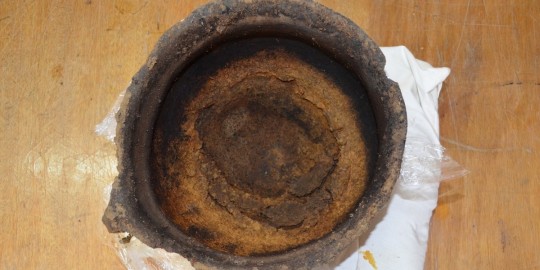
Archaeologists in Denmark have found evidence of a 3,000 year-old cooking mistake that casts some light into the everyday life of Scandinavian Bronze Age people.
Clear evidence for one of the most common mistakes in the kitchen – burning food – lay in a clay pot that was excavated in central Jutland, Denmark.
The clay vessel was found, upturned and in near mint condition, at the bottom of what was once a waste pit.
“The pot is typical for cooking vessels in this region of Denmark. It was accompanied by several other objects fitting the dating,” archaeologist Kaj F. Rasmussen from Museum Silkeborg, Denmark, told Discovery News. Read more.
[fucks up dinner and just straight-up buries the evidence] We’re Getting Ancient Pizza Tonight, Girls
one time when i was 13 i burned pudding and couldn’t get it out of the pot and i was so ashamed i buried it in the backyard so no one would know
i’m watching this documentary about halloween and there’s a part where they’re explaining that ghost stories got really popular around the civil war no one could really deal with how many people went off and died and
the narrator just said
“the first ghost stories were really about coming home”
IIRC, the Civil War also played a huge part in forming the modern American conception of heaven as this nice, domestic place where you’re reunited with your loved ones. People (particularly mothers) responded to the trauma of brother-killing-brother by imagining an afterlife in which families would once again be happy together.
(also not doing this in the correct tag-style, because I wanna KNOW— )What documentary is this? Or is there more than one? Any books on the subject? THIS IS FASCINATING.
cool (ghost) story, bro.
reblogging because, as a us history phd student, i want to say YAY for how much of this is totally on point. i also want to rec the book where a lot of this is covered very, very well, which is Drew Gilpin Faust’s “This Republic of Suffering: Death and the American Civil War.”
a lot of books on the Civil War are deadly dull because they’re about battles and shit, but as a transformative moment in mindset and ideology, it becomes *fascinating*
the other book I’d even more highly rec is David W. Blight’s “Race and Reunion,” which is about how the “(white) brother against (white) brother” image of the war was invented and how throwing African Americans to the merciless viciousness of post-Reconstruction racist whites was part of constructing this “oh everybody was white men and everybody was noble let’s celebrate them all” approach to Civil War remembrance
very good stuff
Thank you! This looks like exactly the sort of reading I’m after! *adds to wish list*
Also, look for David Blights recordings of his Yale lecture series on The Civil War. 21 hours of class lectures, and its FASCINATING. He barely touches on the battles other than to use them as timestamps as to what was going on. Most of it focuses on what the mindset of everyone was going into the war, and what happened on the way out. It’s an amazing series that will change your entire perception of the war – how it happened, and how it wasn’t going to be possible to avoid it, because of the inherent evil of slavery and how it was destroying damn near *everyone* except rich white people.
I didn’t know about the free Blight lectures. You can listen to them here:
my fave greek history story to tell is that of agnodice. like she noticed that women were dying a lot during childbirth so she went to egypt to study medicine in alexandria and was really fucking good but b/c it was illegal for women to be doctors in athens she had to pretend to be a man. and then the other doctors noticed that she was 10x better than them and accused her of seducing and sleeping with the women patients. like they brought her to court for this. and she just looked at them and these charges and stripped in front of everyone like “yeah. im not fucking your wives” and then they got so mad that a woman was better at their jobs then them that they tried to execute her but all her patients came to court and were like “are you fucking serious? she is the reason you have living children and a wife.” so they were shamed into changing the law and that is how women were given the right to practice medicine in athens
I love how humans have literally not changed throughout history like the graffiti from Pompeii has people from hundreds of years ago writing stuff like “Marcus is gay” “I fucked a girl here” “Julius your mum wishes she was with me” and leonardo da vinci’s assistants drew dicks in their notebooks just for the banter and mozart created a piece called “kiss my ass” so when people wish for ‘today’s generation’ to be like ‘how people used to’ then we’re already there buddy we’ve always been
The Hagia Sophia has inscriptions that were considered sacred for centuries until they were deciphered in the 70s to be Nordic runes saying “Halfdan wrote this”




 AllHailMephlis' Blog